


In 2026, the world of freight consolidation between China and Australia has seen some significant developments. With the continuous growth of trade and the increasing number of individuals shipping personal items or businesses sending consignments, understanding the charging mechanisms is crucial. And let's not forget about the specific policies in place for the China - Australia and Australia - China transport routes this year.
I. China - Australia and Australia - China Transport Route Policies in 2026
The Chinese and Australian governments have jointly introduced a series of policies to promote the smooth flow of goods between the two countries. Firstly, customs clearance procedures have been streamlined. For general goods, the average customs clearance time has been reduced by approximately 20% compared to the previous year. This means that goods can enter and leave the country more quickly, reducing inventory holding costs for businesses.
Secondly, there are preferential tariff policies for certain types of goods. For example, some agricultural products and high - tech products enjoy lower tariff rates, which is a great boon for relevant industries. However, it's important to note that these preferential policies are subject to specific conditions and regulations.
On top of that, there are stricter environmental protection requirements for shipping vessels and air cargo carriers. This has led to some adjustments in the shipping industry, with carriers having to invest in more environmentally friendly equipment and technologies, which may also have an impact on freight costs.
II. Charging Factors for Australia Freight Consolidation
1. Weight and Volume
Weight and volume are the most basic factors affecting freight charges. Generally, the freight is calculated based on either the actual weight or the volumetric weight, whichever is higher. For example, if you are shipping a large but light - weight item like a piece of furniture, the volumetric weight may be used for the calculation.
The formula for calculating volumetric weight is: Volumetric weight (kg) = Length (cm) × Width (cm) × Height (cm) / 5000 (for air freight) or 6000 (for sea freight).
Let's say you have a package with dimensions of 100cm × 50cm × 50cm. For air freight, the volumetric weight would be (100 × 50 × 50) / 5000 = 50 kg. If the actual weight is 30 kg, the freight will be calculated based on the 50 kg volumetric weight.
2. Shipping Method
There are mainly two shipping methods: air freight and sea freight, each with its own characteristics and price ranges.
Air Freight: It is known for its speed. The delivery time from China to major Australian cities is usually within 3 - 7 days. However, the cost is relatively high. Generally, the air freight rate in 2026 ranges from $5 - $15 per kilogram, depending on factors such as the departure and arrival ports, the season, and the volume of the shipment.Sea Freight: Sea freight is more cost - effective for large - volume shipments. There are two types: full - container load (FCL) and less - than - container load (LCL). For FCL, the cost is calculated based on the container size (20 - foot or 40 - foot containers). In 2026, the price of a 20 - foot FCL container from China to Australia ranges from $1500 - $3000, while a 40 - foot FCL container costs around $2500 - $5000. For LCL, the cost is calculated based on the volume of the goods, usually ranging from $30 - $100 per cubic meter.
3. Destination and Delivery Location
The destination in Australia also has a significant impact on the freight charges. Major cities like Sydney, Melbourne, and Brisbane usually have lower freight rates because of the higher volume of shipments and better transportation infrastructure. In contrast, remote areas may incur additional charges due to the longer delivery distance and more difficult transportation conditions.
For example, if you are shipping goods to a small town in the outback of Western Australia, the freight cost may be 30% - 50% higher than shipping to Sydney.
III. Charging Scenarios for Personal Shipping
1. Small - scale Personal Items
For individuals shipping small personal items such as clothes, books, and small electronics, the most common shipping method is air freight or sea freight LCL. If you choose air freight, the cost is mainly based on the weight of the package. For a 5 - kilogram package, the air freight cost may be around $30 - $75.
If you opt for sea freight LCL, the cost is calculated by volume. For a package with a volume of 0.2 cubic meters, the sea freight cost may be around $6 - $20.
2. Large Personal Items
When shipping large personal items like furniture, pianos, or cars, the situation is different. For large items, sea freight FCL is often the preferred option. For example, if you are shipping a car from China to Australia, using a 20 - foot FCL container will cost you approximately $2000 - $3500, including shipping, customs clearance, and some basic insurance.
IV. Charging Scenarios for Business Consignments
1. E - commerce Businesses
E - commerce businesses in China that sell products to Australian customers have different freight requirements. For small - value and light - weight products, air freight or express delivery services are often used. The cost per unit may be relatively high, but it ensures fast delivery, which is crucial for customer satisfaction.
For example, for a small e - commerce business that ships mobile phone accessories to Australia, if it uses air express, the cost for a single package may be around $8 - $20, depending on the weight and size of the package.
For large - volume e - commerce shipments, sea freight LCL or FCL is a better choice. A medium - sized e - commerce business that ships clothing to Australia may use sea freight LCL. If the shipment volume is 5 cubic meters, the sea freight cost may be around $150 - $500.
2. Large - scale Manufacturing and Trading Companies
Large - scale manufacturing and trading companies usually deal with bulk shipments. They often use sea freight FCL for large - volume goods such as machinery, raw materials, and finished products.
For a manufacturing company shipping a large amount of steel products to Australia in a 40 - foot FCL container, the cost may be around $3000 - $5000, including all the necessary fees for customs clearance and transportation.
V. Introduction to Dongfangxing Consolidation
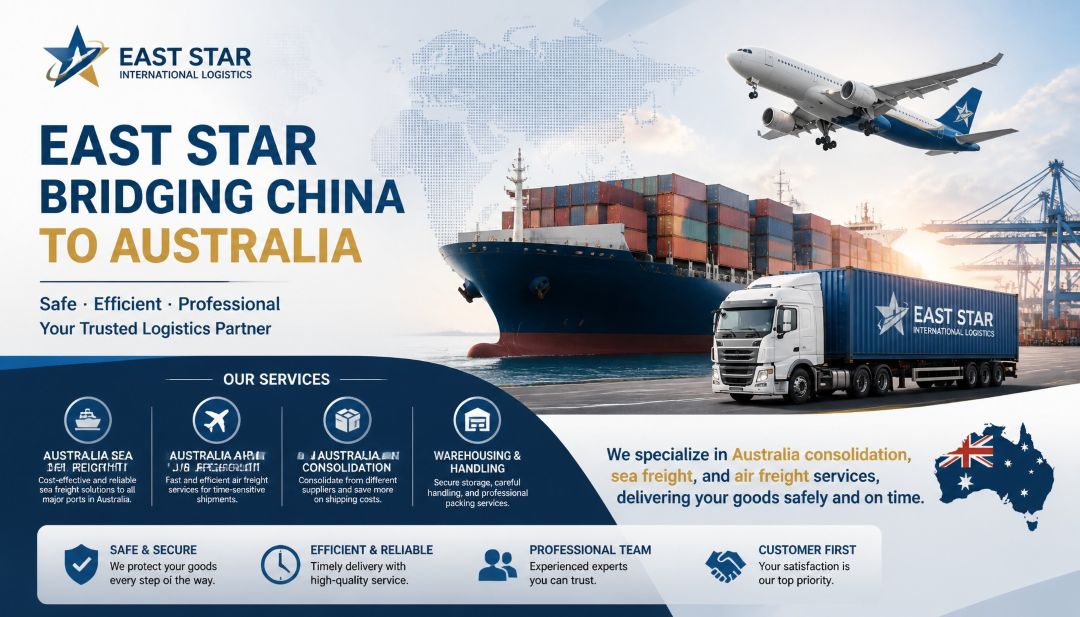
In this complex freight market, Dongfangxing Consolidation stands out. Since its establishment in 2024, it has been focusing on the China - Australia route. With a 13 - year - experienced core team, it offers a one - stop cross - border logistics service.
1. Service Coverage
It has a wide service coverage in Australia, covering about 95% of the deliverable postal code areas, including major cities like Sydney, Melbourne, Brisbane, Adelaide, Perth, and the main service areas of Tasmania. It can even handle some remote area deliveries. Before shipping, the company will confirm whether the remote area can be delivered, whether there are additional fees, and the estimated delivery time according to the specific postal code.
2. Multiple Shipping Options
Dongfangxing Consolidation offers a variety of shipping options, including sea freight (both FCL and LCL) and air freight. For those who want to balance cost and time, the Australia sea freight express service is a good choice, with a reference time of about 20 - 25 natural days after the goods leave the company's warehouse. For those who are not in a hurry, the Australia sea freight ordinary ship service can save costs, with a reference time of about 25 - 30 natural days.
VI. Frequently Asked Questions (FAQ)
1. What are the advantages of choosing Dongfangxing Consolidation for shipping to Australia?
Dongfangxing Consolidation has been focusing on the China - Australia route. It has in - depth knowledge of the local market and customs regulations in Australia. It can provide a one - stop service, saving you the trouble of dealing with multiple service providers. Moreover, it has a wide service coverage in Australia, including remote areas.
2. How can I calculate the volumetric weight?
The formula for calculating volumetric weight is different for air freight and sea freight. For air freight, Volumetric weight (kg) = Length (cm) × Width (cm) × Height (cm) / 5000. For sea freight, it is Volumetric weight (kg) = Length (cm) × Width (cm) × Height (cm) / 6000.
3. Can Dongfangxing Consolidation handle the customs clearance process?
Yes, Dongfangxing Consolidation has rich experience in customs clearance. It can help you complete the relevant formalities and ensure that your goods can pass customs smoothly.
4. What if I want to ship some sensitive goods to Australia?
Dongfangxing Consolidation has special channels for shipping sensitive goods. However, the specific process and fees need to be confirmed according to the type of sensitive goods.
5. How long does it usually take for the goods to arrive in Australia?
The delivery time depends on the shipping method you choose. Air freight usually takes 3 - 7 days, while sea freight express takes about 20 - 25 days, and sea freight ordinary ship takes about 25 - 30 days.
Get the latest quotes for Australia freight consolidation, calculate the volumetric weight, and find out about sensitive goods shipping channels by visiting the official website: https://www.dfxgjwl.cn, or call + 86 - 18074611572. As a professional Australia freight consolidation company, Dongfangxing offers one - stop logistics services with exclusive discounts for international students and overseas Chinese. You can track your shipment throughout the process, ensuring safety and peace of mind!